The Coexistence of Faith and Reason: Habermas’ Theoretical Framework of the Post-Secular Society
This article examines Jürgen Habermas’ concept of the post-secular society as a framework for understanding how religion and secular reason can coexist in modern public life. It argues that religious communities can still contribute meaningfully to democratic discourse, especially through the translation of moral values into a language accessible to all citizens.
RELIGION AND POLITICS
Zainun Nur Hisyam Tahrus
7/8/2022
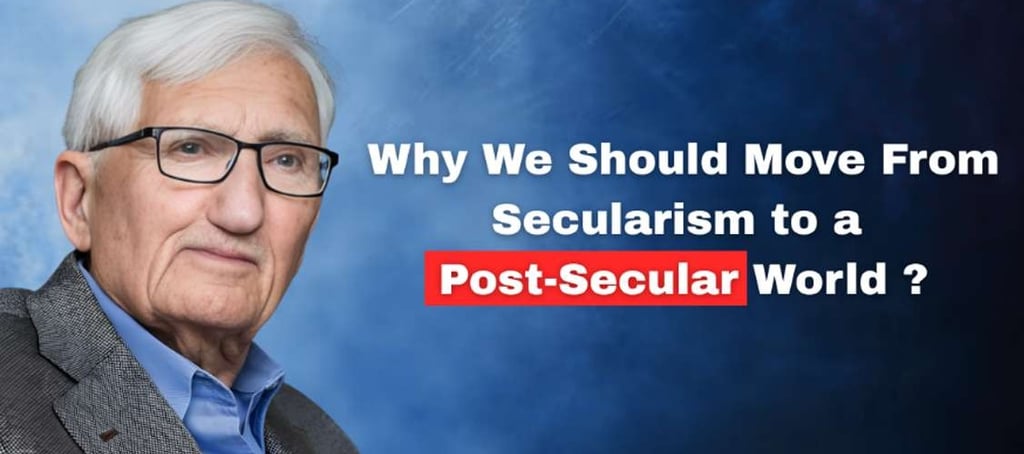
In this article, I explore Habermas’ theory of the post-secular society as a response to the shortcomings of classical secularization theory. My starting point is the observation that religion has not disappeared from modern society, as many older secularization theorists predicted. Instead, religion continues to shape public life, political discourse, and moral imagination in many parts of the world. For that reason, I read Habermas as offering a more balanced framework for understanding the relationship between faith and reason in contemporary society.
I focus especially on Habermas’ idea of discursive translation, namely the expectation that religious citizens may bring their convictions into the public sphere, but in a form that can be understood within a generally accessible language. I argue that this proposal is valuable because it avoids two extremes at once: religious fundamentalism on the one hand, and excessive secularism on the other. In that sense, I present Habermas’ post-secular society as a possible mediating framework for negotiating religious diversity and democratic coexistence, including in a context such as Indonesia. My method in this article is a literature review of Habermas’ speeches, essays, and related scholarly critiques, through which I reconstruct the sociological and philosophical foundations of his argument.
At the same time, I do not treat Habermas’ theory as complete or beyond criticism. I engage objections raised against the concept of discursive translation and against the assumption that religious meaning can always be translated into secular language. My conclusion is that Habermas’ framework is most convincing when applied to the moral-practical dimension of religion, where shared ethical concerns can indeed enter public reasoning. However, I also argue that the theory still needs further conceptual development, especially when applied beyond Europe and when dealing with religion as it is lived at the everyday, micro-social level.